
This is one of our favourite walks for discovering Bingley as a first time visitor or even as a resident. It will take you all around the town on a walk of discovery. Bingley is an old market town and was granted the status in 1212 by King John. It also has a textile industrial heritage which you can’t miss in the urban landscape with its many chimneys. However, the most interesting features you will see on this walk are Myrtle Park and Prince of Wales Park, and the Leeds and Liverpool Canal with its Five Rise Locks – the town’s crown jewel. But the real highlight awaits above the town: Gilstead Moor, the moorland ridge above Bingley, where Gilstead Crag rises from the heather with panoramic views across the Aire Valley and beyond.
Note: Gilstead Moor near Bingley, West Yorkshire should not be confused with the fictional location of Ghyllstead Moor in Northumberland – a common mix-up for visitors who have seen the filming locations for the TV series Vera!
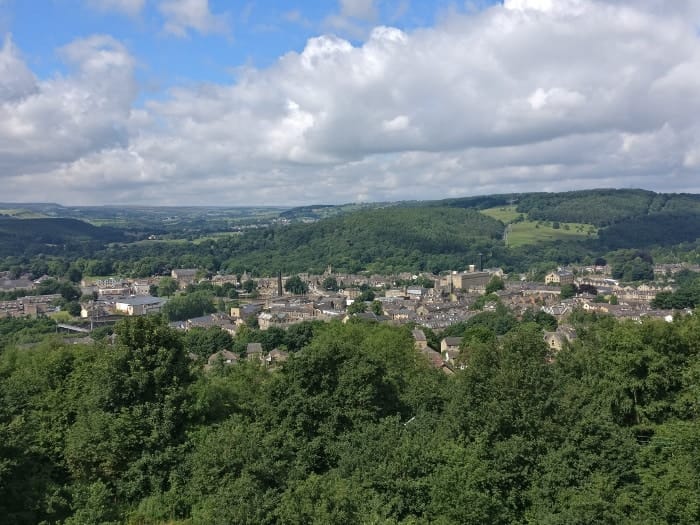
Panoramic view of Bingley from Gilstead Crag on Gilstead Moor, with St Ives Estate and Harden Valley beyond
Plan your walk
Where to start?
Bingley Railway Station
Wellington Street
Bingley
West Yorkshire
BD16 2NA
Grid Reference: SE 108 391
What3Words: ///boat.sideburns.comet
This is a car-free train walk! We encourage walkers to use public transport, rather than cars, as much as possible.
We have provided an interactive map below, powered by OpenStreetMap. You can zoom in and out, explore the route in detail, follow your live location along the walk, and view points of interest, cafés and facilities directly on the map.
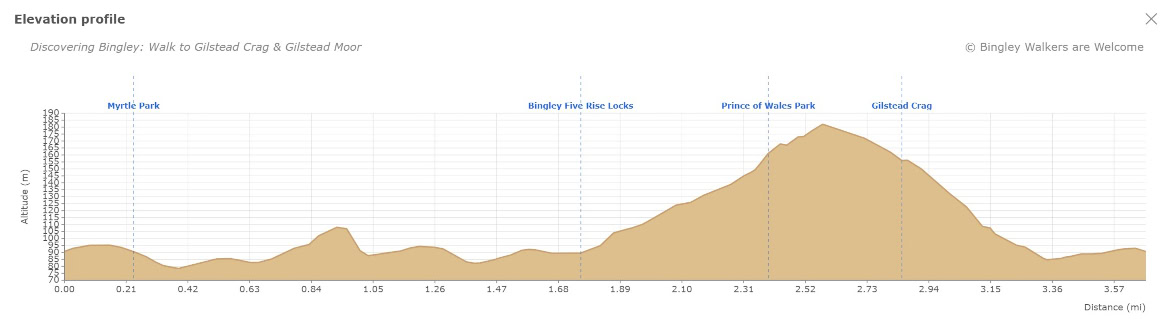
Elevation profile
Route files for GPS & mapping apps
Find out more about these downloadable files and how to use them


Toilets & Refreshments
There are public toilets on this walk and are located on Myrtle Place (by the market square) in Bingley.
There are many shops, cafés, restaurants and pubs in town but below are specifics businesses which we recommend if you go on this walk. Feel free to visit their site and contact them.

A traditional Yorkshire pub near Ireland Bridge serving locally renowned beers and great food
A café located near the Five Rise Locks and a great break half way through your walk.
A multi-award-winning café and small family business in the heart of Bingley
Directions - Walk to Gilstead Crag & Gilstead Moor
Last edited: 14th April 2026
1. Railway Station to Beckfoot Packhorse Bridge.
Starting from the railway station, make your way towards Market Square via the alley way on the side of Peacock Bar. Cross Main Street and go towards Bingley Arts Centre. Once there, have a look at the historical Bingley Market Hall and Butter Cross – to the right of Bingley Arts Centre. This reminds us that Bingley is an old market town and was granted the status in 1212 by King John. Then from here, the walk will take you towards Myrtle Park. Go left on a street called Myrtle Place leading towards Myrtle Grove and the entrance of Myrtle Park. You should see Bingley Pool on the right and the new Lidl supermarket on the left. Once in the park, keep the path going left after the cenotaph and the playground and go down towards the river. Cross the bridge over the River Aire, follow the alley along the allotments and once at the end turn right towards an old hamlet. There you will find the old Beckfoot Packhorse Bridge over Harden Beck.
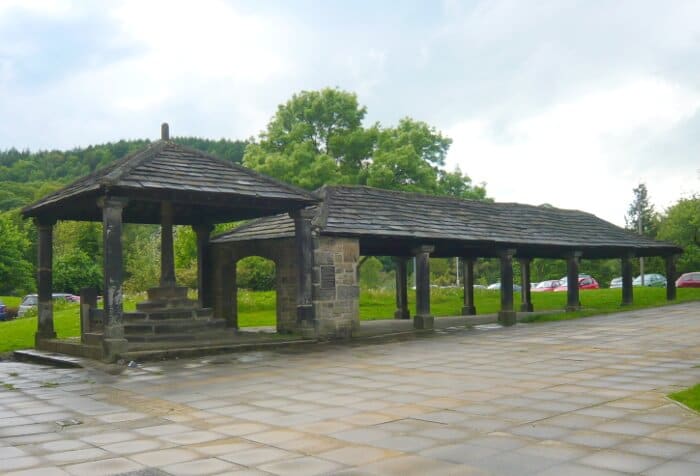
View of the historical Bingley Market Hall and Butter Cross on Market Square. Photo: Régine Geldhof
2. Beckfoot Packhorse Bridge to Harden Road
Cross over the packhorse bridge and take a right turn just after it through a hole in the wall to find yourself in a field. Then go up the river bank towards a house at the top. Walk in front of the house keeping to the path above the river bank – please be considerate to the house owners and only leave footprints! Go through the narrow hole in the wall and you’ll enter a stretch of woodland that forms part of the Bradford Pennine Gateway National Nature Reserve – a designated NNR protecting the river corridor and its wildlife along this section of the Aire. Follow the path through the woods and when you’ve reached some steps, go right and you should arrive in a meadow close to the river and see a green tubular steel foot bridge. This bridge was erected in 1951 for the Festival of Britain. Do not cross the river on the bridge, stay on its left hand side and walk across the meadow towards a path in the woods which will lead you to Harden Road.

View of Beckfoot Farm and Beckfoot packhorse bridge above the Harden Beck in Bingley
3. Harden Road to Five Rise Locks
Once on Harden Road, turn right going down the road towards the Brown Cow pub
Note: Brown Cow pub is a great place to have a drink, so don’t hesitate to have a break there!
From there, cross Ireland Bridge over the River Aire towards Main Street. You should see All Saints Church on your left hand side – one of Bingley’s oldest landmarks, with parts of the building dating back to the 12th century. The stretch of road in front of the church is Old Main Street, the historic heart of Bingley and the oldest part of the town, where you can still see some of the original stone buildings that lined the ancient market route. At the lights, cross the road and turn left, pass the Fire Station and on the right you will find a pedestrian bridge crossing over the bypass which was named after Bingley born astronomer Sir Fred Hoyle. Make your way towards the Leeds and Liverpool Canal. Once on the canal, the first set of locks you will see is the Three Rise Locks with the Damart Mill chimney in the background – a striking reminder of Bingley’s textile past. Go left and follow the towpath, then after the first turn you can’t miss the astonishing Five Rise Locks – see picture. This staircase lock is the tallest of its kind in the country, a remarkable feat of 18th century engineering. Opened in 1774, it was a key element in the economic development of Bradford’s textile industry, allowing heavily laden barges to climb over 59 feet in one continuous flight. The canal and the locks are now cared for by the Canal & River Trust. Take a look at our Bingley Five Rise Locks Family Walk to find out more about this iconic site.
Note: At the top of the locks is the Five Rise Locks café. Another great place for a break and an ice cream!

View of All Saints Church on Bingley Old Main Street

View of Bingley Five Rise Locks from the bottom of Leeds & Liverpool Canal
4. Five Rise Locks to Prince of Wales Park
Cross the Five Rise Locks on the swing bridge, then make your way towards Beck Lane and follow the road with the allotments on your right. This is a residential area full of charm, lovely gardens and quiet alleyways – or snickets as we say locally. Where Beck Lane meets Hall Bank Drive, you will find a snicket opposite leading to Gawthorpe Drive. Once there, on the left you can take a look at Gawthorpe Hall through the gates. This grade II listed building is probably one of the oldest in Bingley. It’s a private property, so unfortunately no visit is allowed unless you are authorised.
Then from here it’s all up hills! From Gawthorpe Drive, turn right and make your way towards Spa Lane which leads onto Park Road. Stay on the left hand side and go up the road. Cross Lady Lane and in front of you is the Prince of Wales Park. Opened in 1865 and named after the then Prince of Wales, the future King Edward VII, this park has recently undergone a full restauration. The Friends of Prince of Wales Park are now looking after the park and received many grants to make it what it is today. Well worth a visit!

Four different paths at the Prince of Wales Park
5. Prince of Wales Park to Gilstead Crag
Go through the park entrance and pass the beautiful lodge. After the bend, turn right and follow a path going up until you reach a path junction. Carry on straight towards the park exit. Then you’ll need to cross Parkside Road – be extremely careful on this busy road. Opposite are a couple of garages and on the left is a track. Start walking on the track but as soon as you can, take a path going up through the wooded area.
This will bring you out onto Gilstead Moor – a small area of open access moorland on the edge of Bingley, overlooking the Aire Valley. At its heart is Gilstead Crag, a dramatic gritstone outcrop characteristic of the South Pennines, where a bench rewards all the climbing with one of the finest views in the area. On a clear day you can see across Bingley town, the Harden Valley, and as far as the Worth Valley to the north. In late summer, the surrounding heather is in full bloom – well worth timing your visit for.
Interesting fact: It takes about 2 hours to do this walk, and if you time it for sunset, you are in for a real treat on top of Gilstead Crag. It only takes about 15 minutes to finish the walk from here, and the route is well-lit.

Gilstead Moor above Bingley - moorland views across the Aire Valley

Panoramic view of Bingley from Gilstead Crag, Gilstead Moor
6. Back to town
Make your way towards the communication tower in the distance, still walking on top of Gilstead Crag. Near the communication tower are a group of rocks high above the valley. Again a fantastic spot for admiring the valley and looking down at Bingley. You will now need to make your way down. Use the path just before the communication tower to find yourself below the the group of rocks and onto a well defined path. Turn right on the path up until you reach a junction, turn left and go down the path with a fence on your right. You should now see some houses and a tarmacked road called Moorbottom Lane. Turn right and the road will soon become a narrow track between gardens. At the end of the track you are now at the junction of Fernbank Drive, Crownest Road and Crownest Lane. Turn right on Crownest Lane and after 30 yards, opposite the road and behind a tall narrow house is the entrance to a snicket – sign posted “Public footpath". Walk down the path, turning left at the bend (don’t go through the wooden gate) and carry all the way up until you’ve reached Belgrave Road. Turn right and then left on Percy Street. Right on Mornington Road and left on Britannia Street. At the bottom, cross the canal and bypass on the pedestrian bridges. After the zebra crossing, turn right onto Ferrand Street where you should see the Aldi supermarket from. Pass the Bingley Five Rise Taxi, cross the car parks and go back towards the train station to finish this walk.
Note: if you are looking for a place to stop for refreshments or something to eat, we recommend The Loft Café Bar, on Main Street only a stone throw away from the train station.

Leeds & Liverpool Canal - View of St Ives estate in the background
Frequently asked questions
Is the Discovering Bingley walk suitable for families with young children?
The walk is family friendly and suitable for older children who are comfortable walking for around 2 hours. However, it is not suitable for pushchairs or buggies – the route includes rocky paths, uneven terrain and steps, particularly on the climb up to Gilstead Crag. For families with very young children, we would recommend one of our flatter walks along the Leeds and Liverpool Canal like the Five Rise Locks & North Bog walk.
Is the Discovering Bingley walk dog friendly?
Yes, this walk is fully dog friendly throughout. There are no sections with livestock along the route, so your dog can enjoy the walk with you from start to finish. Gilstead Moor is a particularly enjoyable stretch for dogs, with open moorland to explore. Just remember to keep your dog under control near other walkers and to bring water for them, especially in warmer weather.
Is there parking near the start of the walk?
Yes. Wellington Street Car Park is located directly in front of Bingley Railway Station, making it the most convenient option if you are driving to the start of the walk. However, as this is a car-free train walk, we encourage walkers to use public transport where possible – Bingley Station is well served by trains on the Airedale Line from Leeds and Bradford.
Is Gilstead Moor near Bingley the same as the one in Northumberland featured in Vera?
No – these are two entirely different places. Gilstead Moor is a small moorland area on the edge of Bingley in West Yorkshire, sitting above the Aire Valley as part of the wider Rombalds Moor plateau. The locations filmed for the TV series Vera are in Northumberland, over 100 miles to the north. And Ghyllstead Moor was featured in the 14th and final series of the ITV drama specifically around the village of Glanton, which was renamed Ghyllstead for the production. The similarity in name causes a common mix-up in search results, so if you have arrived here looking for Vera filming locations, you are in the wrong county – but we hope you stay and explore Bingley anyway!
Is Gilstead Moor open access land?
Gilstead Moor is not designated Open Access land under the Countryside and Rights of Way Act. Access to Gilstead Crag and the moorland area is via public footpaths, which this walk follows throughout. Please stick to the paths and be respectful of the surrounding area.
Are there cafés or pubs along the Discovering Bingley walk route?
Yes, there are several great places to stop along the way. The Brown Cow pub near Ireland Bridge is a traditional Yorkshire pub serving locally renowned beers and food – well worth a break midway through the walk. At the top of the Five Rise Locks you will find the Five Rise Locks Café, a popular spot for a coffee and an ice cream. Back near the station at the end of the walk, The Loft Café Bar on Main Street is a multi-award-winning café and a great place to round off your day in Bingley.
What is the history of All Saints Church in Bingley?
All Saints Church is one of Bingley’s oldest and most significant landmarks, with parts of the building dating back to the 12th century. The church stands on what is believed to be an even earlier Saxon place of worship, reflecting the deep roots of settlement in this part of the Aire Valley. The stretch of road in front of the church forms Old Main Street – the historic heart of Bingley – where original stone buildings still line what was once the ancient market route through the town. The church remains an active place of worship today and is well worth pausing to admire as you pass on the walk.
What is Bingley's history as a market town?
Bingley is one of West Yorkshire’s oldest market towns, having been granted market town status in 1212 by King John. This long history as a centre of trade is still visible in the townscape today, particularly around the Market Square and the historic Bingley Market Hall and Butter Cross, which you pass early on this walk. The town later became a significant centre of the textile industry during the Industrial Revolution, as evidenced by the mill chimneys that still punctuate the skyline and the Leeds and Liverpool Canal – built in part to transport Bradford’s wool and cloth to the ports. This mix of medieval market heritage and industrial history is part of what makes the Discovering Bingley walk such a rewarding way to explore the town.
Have you done this walk yourself? Don’t hesitate to give us some feedback by leaving a comment below!
Linda
This would have been a lovely walk showing the variety and best of Bingley except for the part at Gilstead Crag. There are actually two communications towers and a myriad of paths leaving. We could not find the path mentioned or any with a fence on the right and as a result went way out of our way and ended up at Tulyar Court and had to walk a long way back to the junction of the three roads. Perhaps some photos of the correct paths to take including before the mast, where to turn right and then left with the fence would be useful. Otherwise a lovely walk with plenty of variety. Because of getting lost at the crags, we are reluctant to try another perhaps longer walk
Bingley WaW
Hi Linda, thanks for the feedback. We’ll take a look at the route again and take this into consideration for the next edit of this walk.